 Memory Rolls
Corporate Event Engagement Ideas That Get People Participating
Practical corporate event engagement ideas, from low-risk participation to guest-shot photo albums, with data on what attendees want and how to match each idea to a goal.
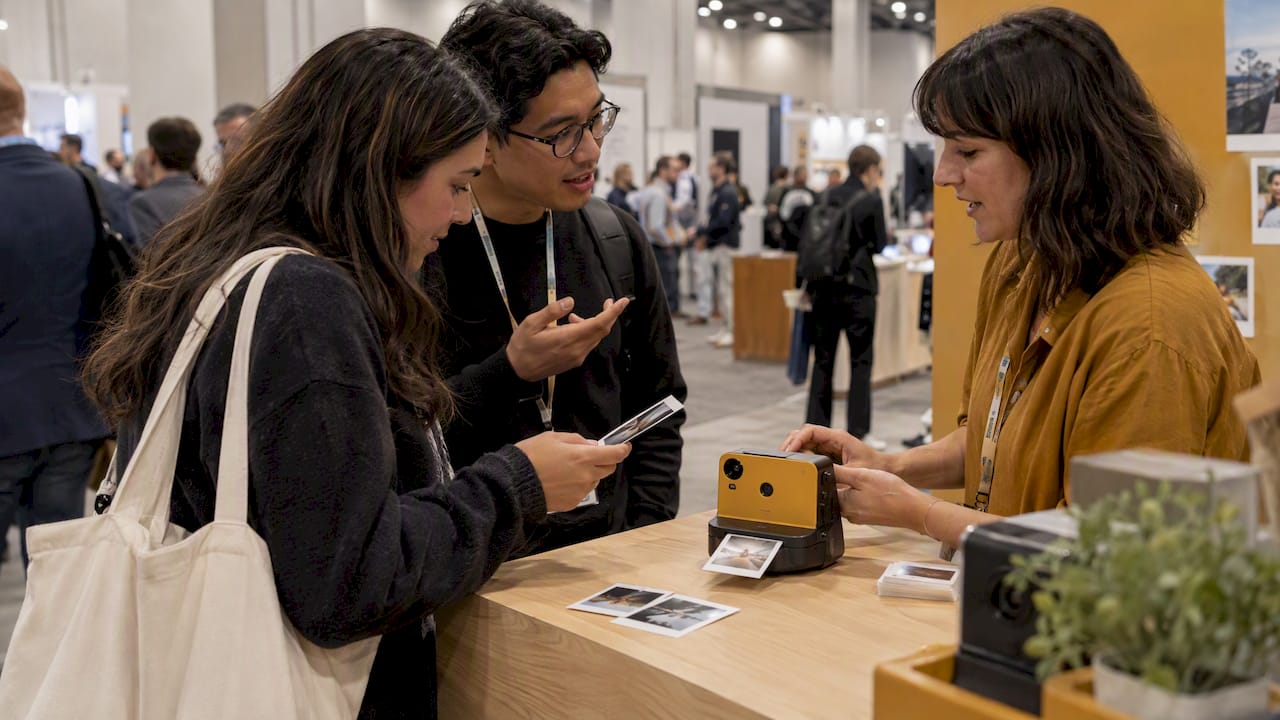
The corporate event engagement ideas that work share one trait: each is built to produce a specific interaction, not just to fill time. Pick a goal first (connection, learning, product discovery, content), then choose a format that makes joining easy for the quiet majority as well as the extroverts. Below you'll find ideas for all-hands meetings, conferences, offsites and brand activations. For each we say who it suits, what it costs in effort, and where it goes wrong.
TL;DR
- Start with a business objective, then pick the activity. Recreation with no goal behind it tends to deliver low returns and can feel disingenuous to employees.
- Offer a ladder of participation: polls and table talk for everyone, stage-level activities as optional extras.
- Design "peak moments" on purpose: hands-on demos, expert conversations, small-group sessions.
- Shared photo capture gives every attendee a way to contribute and gives you content you didn't have to commission.
- Leave free time in the schedule. Engagement drops when every minute is programmed.
Table of Contents
- Start with the goal, not the activity list
- Design for the quiet majority
- Engagement ideas for all-hands meetings and town halls
- Engagement ideas for conferences and expos
- Engagement ideas for offsites and retreats
- Engagement ideas for brand activations and customer events
- Photos as an engagement tool, not an afterthought
- Perspective: what we've learned about guest participation
- Match the idea to the room
- Try the Event Camera at your next corporate event
- How to tell whether engagement worked
- Common mistakes to avoid
- FAQ
- Sources
Start with the goal, not the activity list
Most lists of engagement ideas read like menus: relay races, trivia, escape rooms. The trouble is that none of them tells you which to order. SHRM's guidance on team building argues that good design starts with a team objective, such as cross-functional communication, trust or surfacing internal problems, and that spending on purely recreational activities with no link to those goals yields low returns and can be read by employees as insincere.
So before you shortlist anything, answer three questions:
- What should be different after the event? People who've never met are talking. Sales understands a new product. Leadership hears honest questions.
- Who is in the room? A 40-person leadership offsite and a 600-person conference need different mechanics.
- How much risk will this audience accept? A reserved audience of engineers will not enjoy being pulled on stage, and that's fine.
There is a gap worth noticing here. PCMA's roundup of events research reports that 74% of attendees prioritize immersive experiences to disconnect, yet only 38% of organizers actively prioritize creating them. Most events are designed around content delivery. The ideas below are mostly about closing that gap.
Design for the quiet majority
Audience participation works on a risk spectrum. Pult Event's guide to audience participation points out that low-risk options such as polls and table conversations are essential for mixed or reserved groups, while high-risk ones such as on-stage improvisation or debates should never be the only path to interact. The practical rule: every moment of your agenda should have at least one low-friction way in.
| Risk level | Examples | Best for |
|---|---|---|
| Low | Live polls, table prompts, anonymous questions, taking photos of what you see | Mixed audiences, new teams, large rooms |
| Medium | Small-group breakouts, speed networking with prompts, team challenges | Offsites, workshops, cross-functional groups |
| High | Panels with audience debate, lightning talks, on-stage games | Established teams, volunteers only |
If you only have budget for one change, add a low-risk layer to the sessions you already have. It costs little and it raises the share of people who take part.
Engagement ideas for all-hands meetings and town halls
Replace the podium with a smaller room. Leadership coaches recommend humanizing executives: coffee chats or breakouts of 8 to 10 people instead of a formal stage, which TeamOut's all-hands ideas say lowers anxiety and encourages candid Q&A. For a big company, run the breakouts in parallel after a short plenary and have each executive host one.
Run a structured retrospective. Borrowed from agile software teams, the three questions "What went well? What didn't? What will we change?" are described by practitioners writing on employee engagement as a cheap way to build psychological safety and surface operational problems early. It costs nothing but a facilitator and sticky notes, and it often beats expensive one-off social events on return.
Moderated, anonymous Q&A. Let people submit questions from their phones, upvote them, and have a moderator read the top ones. Anonymous input is the textbook low-risk option, and it keeps the loudest voice from setting the agenda.
Make the output visible. Whatever the room produces (votes, themes, decisions) should show up on screen or in a follow-up note within a few days. People participate again when they see participation matter.
Engagement ideas for conferences and expos
Build peak moments around hands-on experiences. PCMA's summary of research cites a figure that should interest anyone running a product event: hands-on product demonstrations raise purchase likelihood by 90%, and meeting a subject-matter expert raises satisfaction by almost 80%. Put your experts at stations, not just on stage, and give attendees a reason to walk up to them.
Protect free time. The Bizzabo benchmarking report found that 73% of attendees emphasize the importance of free time at in-person events. A packed agenda looks like value on paper and feels like fatigue in person. Leave gaps for hallway conversation, and seed them with a prompt board or a conversation table.
Gamify booth visits. A simple stamp card or digital checklist that rewards visiting five stations pushes people toward conversations they'd skip. Tie the rewards to the objective: ask a question at the sponsor booth, try the demo, meet a speaker.
Structured networking instead of "mingle freely". Give people a reason to start talking: a shared question on the badge, a topic table, or a matched intro. Open mingling favors people who already know each other.
Engagement ideas for offsites and retreats
Offsites have the most room to design connection, because people are together for days. Emburse's 2025 offsites research found that high-performing companies reported 73% participation in team dining versus 40% at underperformers, and 46% versus 26% in wellness and relaxation activities. It also found they favor restaurants (50% adoption) and outdoor recreation venues (39%) over conference rooms. Shared meals and outdoor time are not fluff. They're where the relationships form.

Start big, go small. A write-up on a retreat model describes programs that run roughly 2.5 to 3 days, with Monday and Friday as travel days, then move from large-group sessions to small team workshops from Tuesday to Thursday. The logic is sound for any offsite: open with vision and shared context, then break into groups where real work and real conversation happen.
Pair work with something non-work. Building or making something together, cooking, a local volunteering project, or an outdoor challenge lets colleagues see each other in a different role. Keep it optional where physical ability varies, and offer a calm alternative.

Document it as you go. Multi-day trips produce hundreds of moments nobody on the planning team will see. Our guide to company offsite photo ideas covers how to collect them without turning anyone into the designated photographer.
Engagement ideas for brand activations and customer events
Activations succeed when visitors do something rather than watch something. EventTrack's 2026 study of more than 1,000 U.S. marketers and attendees describes live events as a lead discipline for Fortune 1000 brands, driving awareness, content creation and revenue across the marketing portfolio. Content creation is the part many teams under-plan.
A few formats that give visitors something to do and something to share:
- Interactive demos where the visitor handles the product.
- Photo moments: a branded backdrop, a prop wall, or a mirror or 360-degree booth. If you want a staffed entertainment piece, corporate photo booth rentals in the New York area can handle delivery, setup and branded customization.
- Guest-shot photo albums, where every attendee contributes images from their own point of view. More on this below.
- Sustainability touches such as reusable materials and low-waste catering. EventTrack reports that 18% of attendees cited sustainability practices as their top reason to attend an in-person event in 2025, up from 11% in 2023.
Photos as an engagement tool, not an afterthought
Photos are one of the lowest-risk ways to get an entire room to participate. Nobody has to speak, perform or compete. They just look around and capture what interests them. That's why shared photo capture belongs on an engagement list, not only on a logistics checklist.
The usual approaches each have trade-offs:
- A hired photographer gives polished coverage but one perspective, and the images arrive days later.
- A photo booth is fun and shareable but creates a queue and captures posed moments in one corner of the venue. We compare this and other approaches in our piece on photo booth alternatives.
- A hashtag or social wall relies on people posting publicly, which many employees won't do for a work event.
- A shared album with no limit tends to end up with the same twenty photographers and a camera roll nobody sorts.
A QR-code disposable camera sits in the gap. Guests scan a code, take a limited number of photos from their own phone, and the organizer curates the best into a shared album. The cap on shots keeps people choosy and in the moment. For event types beyond this one, our list of events where guest photos shine shows how widely the format travels, and our holiday party photo ideas show how to prompt people toward candid shots.
Ways to prompt participation with photos
- A shot list on the table card. Five prompts such as "the best view of the room", "someone you just met" or "the moment you laughed". It turns a passive scan into a mini scavenger hunt.
- A cross-team challenge. Ask each table to capture one image for each company value, then feature the best in the closing session.
- A "behind the scenes" brief for staff and speakers, so the album shows the work as well as the party.
- A closing slideshow of curated guest photos, shown before people leave. It's a visible payoff for participating.
Perspective: what we've learned about guest participation
We build Event Camera, so we see the same pattern over and over: people participate when the barrier is close to zero. The moment you ask guests to download an app or create an account, a large share of them quietly opt out. That's why our guests only scan a QR code and start shooting, with no app and no sign-up.
The second lesson is about limits. It sounds backwards, but a cap on shots per guest makes the photos better. People think before they press the button, and organizers aren't left sorting through thousands of near-duplicates. The third is control: the organizer curates the shared album, decides who sees what, and can even decide who pays. For a corporate event where a brand or HR team is involved, that curation step is what makes people comfortable sharing in the first place.
Our advice to any planner: treat photos as one participation channel among several, not the whole strategy. Pair it with a real conversation format, give people a prompt, and show the results before the event ends.
— Uday
Match the idea to the room
| Situation | Primary goal | Good fit | Watch out for |
|---|---|---|---|
| Company all-hands, 200+ people | Honest two-way communication | Breakouts of 8 to 10, anonymous Q&A | Q&A dominated by a few voices |
| Conference or expo | Learning and discovery | Expert stations, structured networking | Over-scheduling, no downtime |
| Offsite, 20 to 80 people | Relationships across teams | Shared meals, start-big-go-small agenda, retrospectives | Mandatory physical activities |
| Brand activation | Content and awareness | Interactive demos, guest-shot photos | Content nobody curates |
| Holiday party | Celebration and morale | Photo prompts, low-key games | Forced fun, public posting pressure |
Treat the table as a starting point, then adapt it with what you know about your own people.
Try the Event Camera at your next corporate event
If you want every attendee contributing to a curated album, Event Camera is built for offsites, conferences and company gatherings. Guests scan a QR code, shoot a limited number of photos, and you choose what goes into the shared album. Photos are kept for 90 days, and branding can be customized. Pricing is per event and by headcount, with no subscription: the first five guests are free, then seats cost $1 each for 6 to 25, $0.40 each for 26 to 100, $0.30 each for 101 to 250, and $0.20 each from seat 251, all one-off. Full details are on the pricing page. For activations specifically, see our page on branded disposable cameras for brand activations.
How to tell whether engagement worked
Engagement without measurement is a feeling. Pick one or two signals per goal before the event:
- Participation rate: the share of attendees who joined the poll, scanned the code, or visited a station.
- Quality of conversation: number of cross-team introductions, or questions submitted at an all-hands.
- Content produced: count of photos curated, quotes captured, ideas surfaced.
- Follow-through: how many action items from a retrospective were completed within a month.
- A two-question survey sent the same day: "What was the best moment?" and "What would you change?"
If the numbers are low, look at friction before blaming the audience. Was the entry step too complicated? Was the prompt unclear? Was the best activity scheduled against lunch?
Common mistakes to avoid
- Choosing the activity before the goal. It leads to expensive events that nobody can justify.
- Making the only option a public one. Stage-only activities exclude the reserved majority.
- Overprogramming. No gaps means no conversations.
- Ignoring accessibility. Offer alternatives to physical challenges and make sure every digital step works without special accounts.
- Collecting without curating. Photos, comments and ideas pile up. Decide who will sort them and when, so the best are shared quickly.
- Skipping the follow-up. Send a recap, the best photos and the decisions reached. That closing step is what makes people join in next time.
FAQ
What are some good interactive corporate event ideas on a small budget?
Structured retrospectives, small-group coffee chats with executives, anonymous Q&A from phones, and shared photo albums cost little. They rely on good facilitation and clear prompts rather than rentals or entertainers. Start with one and expand once you see how people respond.
How do you get a quiet audience to participate?
Offer low-risk options first: polls, table discussions, anonymous questions, and photo prompts. Keep stage-based activities optional so nobody is forced into the spotlight. The goal is to let people choose their own level of participation.
How many engagement activities should one event have?
Fewer than most planners think. Choose one or two that serve your main goal and leave real free time between them. Attendees consistently ask for downtime, and over-scheduling reduces the interactions you're trying to create.
Can employees take photos at a corporate event without apps or accounts?
Yes. With a QR-code camera like Event Camera, guests scan a code and shoot from their phone browser, with no download or sign-up. The organizer then curates the shared album, and photos are kept for 90 days.
Sources
- Unpacking a Year of Events Industry Research, PCMA
- The State of Corporate Offsites 2025, Emburse
- EventTrack 2026 study, Event Marketer
- Team Building & Engagement Activities Guide, SHRM
- 45+ Audience Participation Ideas for Any Event
- Building Connection at Scale
- All-hands meeting ideas, TeamOut
- Employee engagement ideas
- State of Events and Industry Benchmarks, Bizzabo