 Memory Rolls
Wedding Photo Booth Alternatives That Guests Actually Use
Skip the booth line and the rental fee. Compare wedding photo booth alternatives by cost, candid shots and effort, from DIY backdrops to a QR code camera.
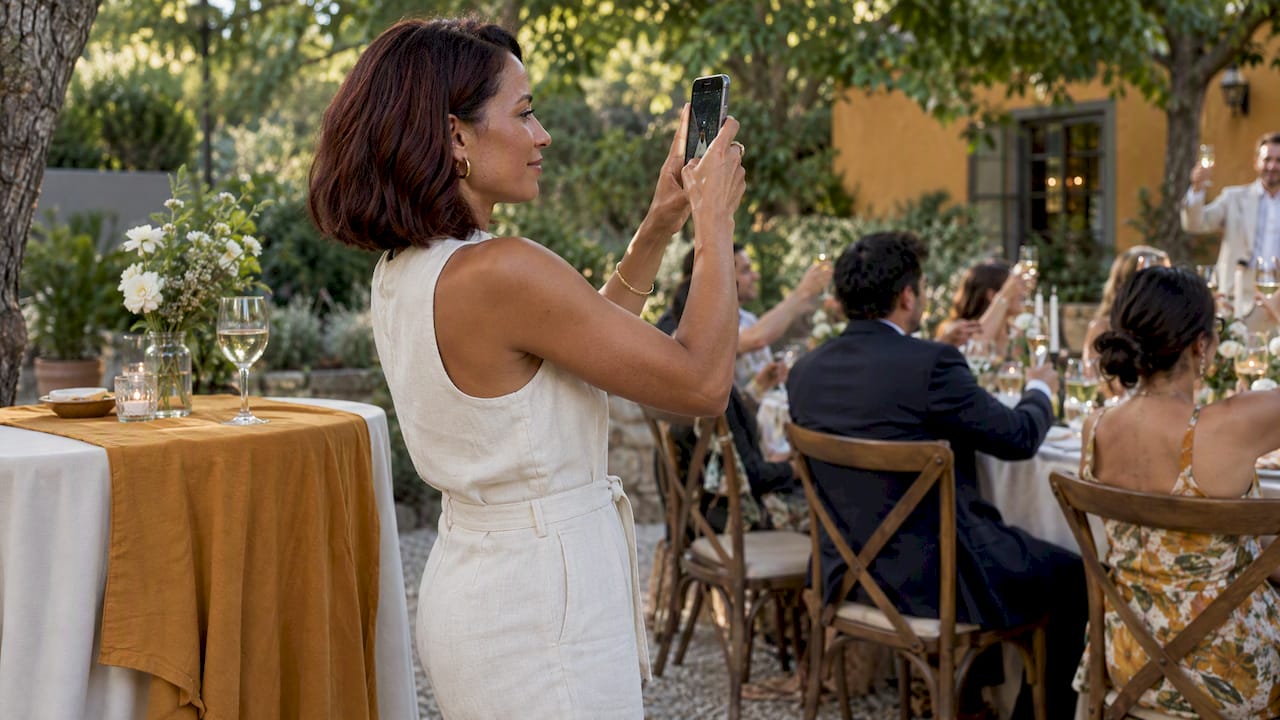
The best alternative to a wedding photo booth depends on what you liked about the booth. If it was the fun, build a styled photo corner. If it was the keepsake, hire a roaming instant-film photographer. If it was the photos themselves, put a camera in every guest's pocket with a QR code. Below, we compare each option on cost, effort and the kind of pictures you end up with, so you can pick one (or combine two) without paying for a booth nobody queues for.
TL;DR
- Photo booths are fun but static. They collect posed shots from whoever stands in line, and miss the dinner tables, the bar and the dance floor.
- Budget options (a DIY backdrop, a flower wall, a neon sign) work best when guests already have phones in hand and you add one clear prompt.
- A QR code camera lets every guest take a limited number of photos from their own phone, with no app or account, and you choose which ones go in the shared album.
- Combine a physical focal point with a digital camera: one gives you the staged moment, the other gives you the whole night.
- Our pricing starts free for the first five guests, then 1 USD per seat for seats 6–25 and falls to 20 ¢ per seat from seat 251.
Table of Contents
- Why couples look beyond the booth
- Seven alternatives at a glance
- The DIY photo corner
- Flower walls, balloons and neon
- A roaming instant-film photographer
- Caricaturists, live painters and other performers
- Disposable film cameras on the tables
- A QR code camera on guests' phones
- Our perspective
- Pairing a pro with guest photos
- Making the QR camera work at your wedding
- What the QR camera costs
- Try it before the wedding
- How to choose
- FAQ
- Sources
Why couples look beyond the booth
Booths are popular for a reason. The Knot's own guide to cheaper options concedes that booths are fun, interactive and leave guests with cute keepsakes, and then points out the practical catch: a booth costs real money and takes up real space.
The money part is easy to check. WeddingWire's cost guide puts starting prices for a three-hour photo booth package at about $551, and says most U.S. couples spend $425 to $1,000 on all wedding rentals combined. For a smaller wedding, a booth can swallow a slice of the budget that would otherwise go to food or flowers.
The other complaints we hear are about the experience:
- The line. One booth serves one group at a time. At a 150-person reception, a third of your guests may never step inside.
- The space. Enclosed booths need a corner, power and a path from the dance floor. Small venues and barn-style spaces often have none to spare.
- The photos. Booth pictures are posed and look alike. A paper on wedding photo kiosks notes that booths give a structured, controlled activity but often miss the candid moments at dinner tables, the bar or the dance floor.
That last point is the one that matters most. If what you want to remember is your grandfather laughing at table nine, a booth will never get it.
Seven alternatives at a glance
| Alternative | What it gives you | Effort | Typical cost level | Candid moments? |
|---|---|---|---|---|
| DIY photo corner | Styled backdrop, guests use their own phones | Medium | Low | Some |
| Flower wall or balloon backdrop | A beautiful focal point | Low to medium | Low to medium | Some |
| Roaming instant-film photographer | Prints in guests' hands | Low (you hire) | Higher | Yes |
| Caricaturist or live artist | A keepsake and a spectacle | Low (you hire) | Medium to high | No |
| Disposable cameras on tables | Film nostalgia | High (collecting, developing) | Medium | Yes |
| Photo-sharing album with a QR code | Every guest's perspective | Very low | Low | Yes |
| Professional second shooter | Better coverage by your hired photographer | Low | Higher | Yes |
Costs depend on your market, so get quotes locally. The ranking below is by how well each option solves the problem a booth leaves behind.
The DIY photo corner
The cheapest swap is a spot where guests choose to take their own pictures. Pick a wall with good light, hang something worth photographing, and add a small sign telling people what to do. Props are optional. A few oversized frames or a mirror often work better than a basket of feather boas.
Three things make or break it:
- Light. Place it near a window, or add a warm lamp. A dark corner makes every phone photo look muddy.
- A prompt. A sign that says "Take a photo with someone you just met" does more than a pile of props.
- A way to collect the results. This is where most DIY corners fail. The photos stay on forty different phones and you never see them. Pair the corner with a shared album so everything lands in one place.
The weakness is the same as a booth's: it's a place, and only the guests who walk to it use it.
Flower walls, balloons and neon
A statement backdrop is the most common substitute you'll see in photo booth alternative lists, and it works because it's visually strong enough to attract guests without any staffing. A faux flower wall, a draped linen arch or a custom neon sign can double as ceremony or sweetheart table decor, so the cost does two jobs.
If you want a softer, more colorful look, balloon installations are cheaper than most people expect. This balloon bouquet backdrop guide shows how bouquets can work on tables and as a photo wall, including easy DIY versions.
A backdrop only creates a place to take photos. It does not create a way to share them, so treat it as the set and add the camera separately.
A roaming instant-film photographer
If your reason for wanting a booth was prints, a photographer who circulates is the closest upgrade. Instead of a static bottleneck, they move through cocktail hour and the reception and hand guests a real instant print on the spot. One example is an instant-film vendor listing on The Knot describing exactly that format, with a curated keepsake album as the goal.
This is a strong choice when:
- You want physical keepsakes for guests or a guest book.
- Your crowd skews older and prefers prints over links.
- You can afford a vendor for a few hours.
It's less useful when you want hundreds of photos from all angles. One person can only be in one place at a time.
Caricaturists, live painters and other performers
Forum threads on this topic keep coming back to live entertainment: a caricaturist, a live painter, even dancers. These are memorable and give guests something to watch, but they're closer to an entertainment booking than a photo solution. Treat them as a complement. You get one great artwork per couple, but you don't get a record of your wedding.
Disposable film cameras on the tables
Film cameras on reception tables are charming and have an obvious nostalgic appeal. They also come with the catch everyone discovers afterward: someone has to collect them, pay to develop the film, and wait. Some cameras come back empty or lost, and shots taken in a dim reception hall often fail.

We compare the film and phone versions in detail in our piece on disposable cameras for wedding tables versus a camera on guests' phones. The short version: if you love the limited-shots feel of film but not the logistics, the digital version keeps the feeling and drops the work.
A QR code camera on guests' phones
This is the option that most directly answers the booth's weakness. Instead of bringing guests to one device, you bring the camera to the guests, on the phone they already carry.
Here's how ours works at a wedding:
- You create the event and get a QR code.
- You put the code on table cards, programs or a sign at the entrance.
- A guest scans it and gets a disposable camera in their browser. There is nothing to download and no account to make.
- Each guest gets a limited number of shots, which keeps people looking at the party instead of reshooting the same selfie.
- All the photos and short videos land in one private album. You pick the best ones to share with everyone.
The no-app part is not a small detail. If you want to know why we hold that line, read why wedding photo sharing without an app matters. Anything that asks a 70-year-old guest to install something at a reception will lose most of your crowd.
The OSTI paper makes the underlying point: smartphones are the de facto way people capture photos at weddings today, because nearly every guest has one on them at all times. The QR approach builds on that habit rather than fighting it.
What you get that a booth can't give you
- Coverage of the whole day. Guests shoot during cocktail hour, at dinner and on the dance floor, not only at one station.
- No line. Two hundred guests can shoot at once.
- No equipment or space. Nothing to set up, power or return.
- Control. You see everything first and choose what goes in the shared album. Our page on making one album from all your wedding guest photos walks through that curation step.
What it doesn't do
It won't hand anyone a printed strip. If prints matter, combine it with a printed table card or a small photo wall of your favorites after the event. Photos are kept for 90 days, so plan to download your album in that window using the bulk download feature.
Our perspective
We built this because we kept watching the same pattern at weddings: the best photos were never the ones taken in front of a backdrop. They were taken by a cousin across the room at the exact moment something happened. A booth captures the people who walk up to it. A guest with a phone captures the moment.
We also think the limit on shots is a feature, not a restriction. When every guest has a small, fixed number of photos, they choose them. The album is smaller and better than an unlimited camera roll dump, and the couple can curate it in an evening rather than a month.
Our honest advice: don't treat any of these as a replacement for your photographer. Your pro covers the formal portraits and the key moments. Everything in this article fills the gaps around that. If you do only one thing, make it a way to gather what your guests see, because that's the part nobody else on your vendor list will deliver.
— Uday
Pairing a pro with guest photos
A photographer is still the right call for the ceremony, portraits and the shots you can't redo. Reception coverage matters too: this reception photography guide explains how to protect moments you can't restage, and it's a good checklist to share with your photographer.
The guest album then adds the angles your photographer can't reach: the bar, the kids' table, the dance floor while your photographer is shooting the cake. If you're unsure how to gather the results, our comparison of six methods for collecting photos from wedding guests covers shared drives, hashtags, QR albums and more.

Making the QR camera work at your wedding
A few small choices change how many guests actually use it:
- Put the code where hands are free. Table cards at the reception are better than a sign by the bar line.
- Tell people once, out loud. Ask your emcee or DJ to mention it during dinner. A quiet card gets scanned by about half the room; a mention gets the rest.
- Pick a shot count that suits your crowd. A smaller count encourages thoughtful shots. A higher count suits a long, multi-event weekend.
- Use it before the wedding. Rehearsal dinners and bachelorette weekends are full of photos you will want. See our ideas for the rehearsal dinner and the bachelorette weekend.
- Decide who pays. You can cover your guests or let each guest pay for their own seat. More on that below.
What the QR camera costs
There are no subscriptions, and you pay once per event. Pricing is per seat, which means per guest who gets a camera, and the per-seat rate falls as your guest count grows.
| Seats | Price per seat (one-off) |
|---|---|
| First 5 guests | Free |
| 6–25 | 1 USD |
| 26–100 | 40 ¢ |
| 101–250 | 30 ¢ |
| 251 and up | 20 ¢ |
| Guest codes | 1 USD |
| Guest-paid event seat | 1.99 USD per person |
The guest-paid option is for events where you'd rather each attendee cover their own seat, such as a bachelorette weekend or a destination wedding where the couple is already paying for plenty. You can see the full breakdown on our pricing page, and your total is calculated at checkout.
Put that next to a rental starting at about $551 and the difference is obvious. You also skip delivery windows, setup time and the three-hour limit.
Try it before the wedding
We offer the first five seats free, so you can test the whole thing with your wedding party before you commit. Scan the code, take a few shots, and look at how the album comes together. When you're ready to set it up for the whole guest list, our wedding camera page shows how the QR code works for a reception, including custom branding for your names and date.
If you are planning something else, we also run events for corporate off-sites and conferences and bars and venues.
How to choose
Use these questions:
- What did you want from the booth? Fun means a backdrop. Keepsakes means a roaming instant-film photographer. Photos of your guests means a QR camera.
- How big is your guest list? Above 100, queues and one-vendor solutions break down. Digital scales without extra cost per hour.
- How mixed is the age range? Anything that needs an app is a risk. A browser-based camera is not.
- How much time do you have? Film cameras and DIY builds need weeks. A QR album needs an afternoon.
- What's the budget? Be honest about what you'd drop to afford a booth. Often the answer is better spent elsewhere.
A combination that works for many couples: one statement backdrop for the aesthetic, a QR camera for coverage, and your photographer for the essentials.
FAQ
What is the cheapest alternative to a wedding photo booth?
A DIY photo corner with a simple backdrop and a sign is the lowest-cost option, because guests use their own phones. A QR code camera is also inexpensive: the first five guests are free with us, and larger guest counts cost cents per seat. Either way, you avoid the rental fee, which starts around $551 for three hours.
Do guests need to download an app to use a QR code camera?
Not with ours. Guests scan the code and the camera opens in their phone's browser, with no app and no account. That keeps it simple for guests of any age.
How long are the photos kept?
Photos are retained for 90 days. Use the bulk download feature to save the full album to your own storage before then.
Can I choose which photos everyone sees?
Yes. The album is private, and you curate the shots before sharing the best ones with all your guests. That means you can leave out blurry or unflattering shots.
Should I still hire a photographer?
Yes. A professional covers the ceremony, family portraits and key moments with skill and equipment that phone photos can't match. Guest photos add the candid angles around those moments.
Sources
- SYSM-5620 Final Paper: Photo Kiosk (OSTI)
- Affordable Photo Booth Alternatives for Weddings (The Knot)
- Instant Photo Chicago vendor listing (The Knot)
- Photo Booths Cost Guide (WeddingWire)